
Understanding the New Energy Efficiency Labels: What They Mean for Your Business
Chapters
- Introduction
- A Brief History of Energy Efficiency Labels
- The New Energy Efficiency Labelling System: Simplifying the Scale
- Factors to Consider with the New Labels
- Energy Efficiency in Lighting: What It Means for Your Business
- Case Study: Ansell Tornado LED Batten – Old vs. New
- Beyond Lighting: New Labels for Appliances
- Case Study: Under Counter Fridges – Old vs. New
- Conclusion
New Energy Efficiency Labels Put Sustainability Front and Centre
As hospitality, retail, warehousing, engineering, and manufacturing businesses strive to reduce operating costs and improve sustainability, understanding energy efficiency labels is essential. Recently, the UK has seen significant changes to the energy efficiency labels for lighting and other electrical products, which may have left some businesses concerned about the quality and efficiency of the products they’re purchasing. In this blog, we'll delve into the evolution of these labels, what they mean for your business, and why the products you rely on are still the best choice for energy savings.
A Brief History of Energy Efficiency Labels
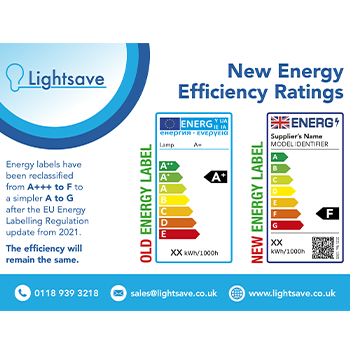
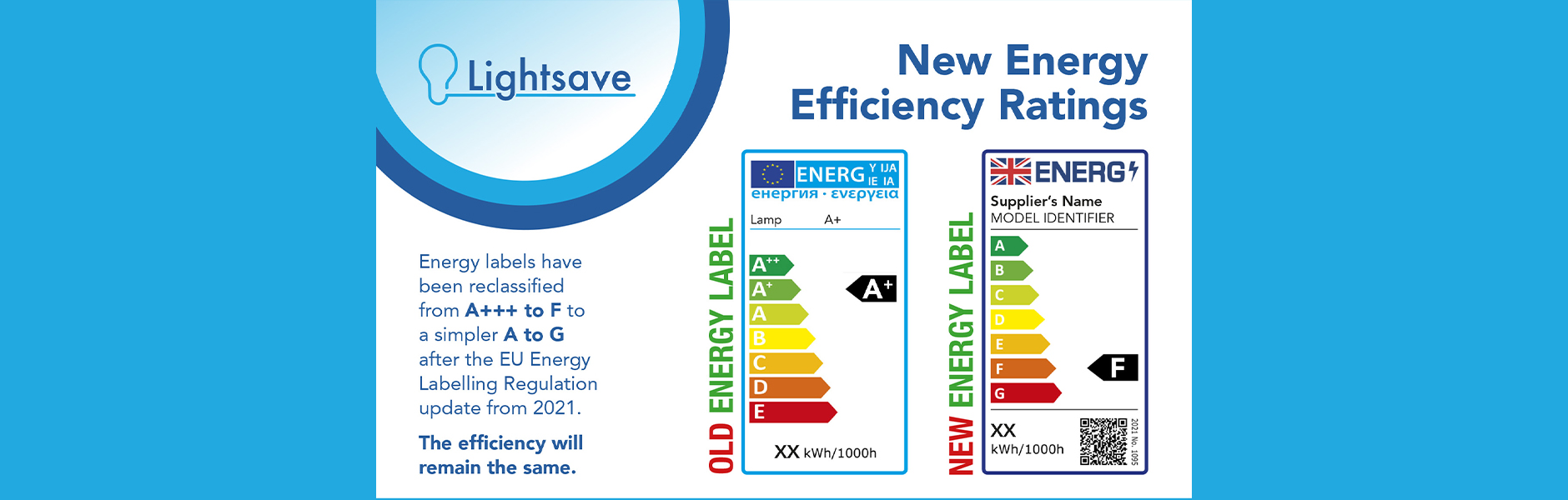
Energy efficiency labels were introduced to help consumers and businesses identify products that consume less energy, thus lowering electricity bills and reducing environmental impact. The original system, established by the EU, classified products from A+++ (most efficient) to G (least efficient). However, this system became increasingly confusing as technological advancements led to an abundance of A-rated products. The distinction between A+, A++, and A+++ became unclear, making it difficult to differentiate between products.
The New Energy Efficiency Labelling System: Simplifying the Scale
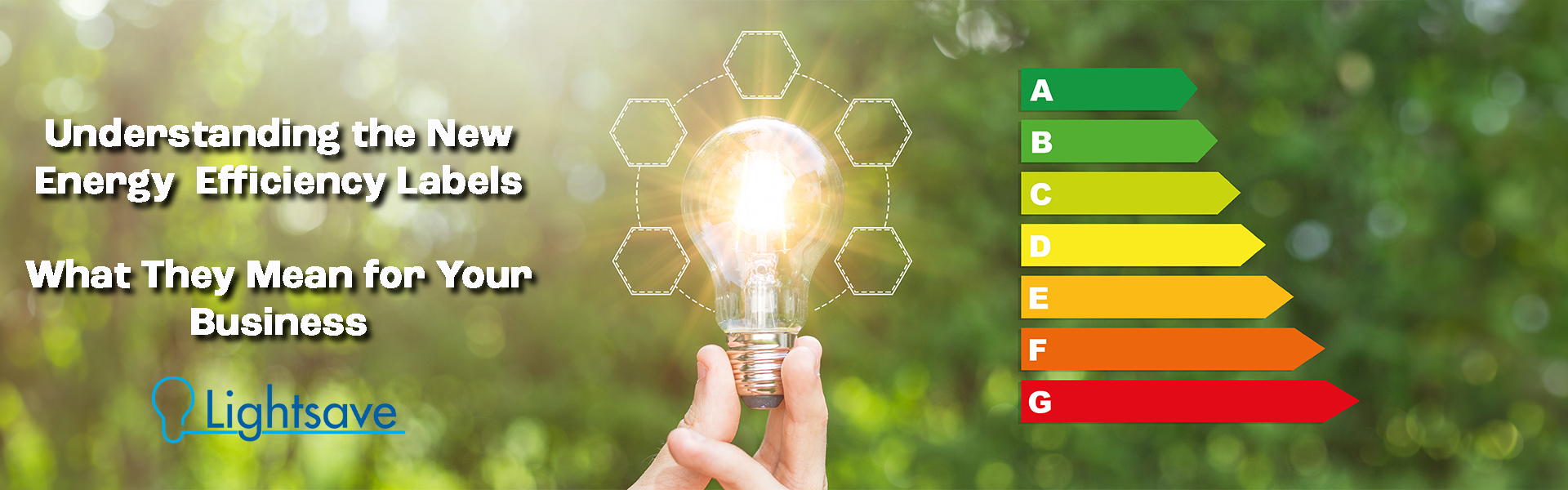
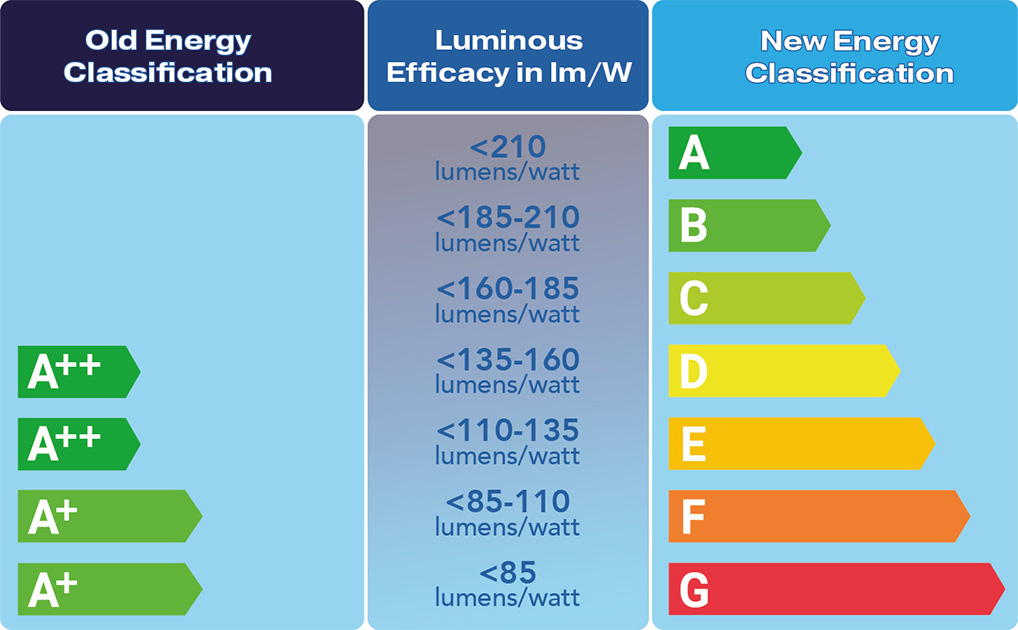
To address this confusion, the energy efficiency labels have been restructured into a simpler A to G scale, where A represents the most energy-efficient products, and G represents the least. The intention was to leave room for future innovation and to make it easier for consumers and businesses to understand the relative efficiency of products.
However, this change has resulted in many previously A-rated products now being classified as C or D, or some rare cases even lower than that. This has understandably caused some concern among businesses that they might be purchasing inferior products. It's important to note that the change in labels does not mean a reduction in product quality or efficiency but rather a recalibration of the scale.
Factors to Consider with the New Labels
When evaluating the new energy efficiency labels, businesses should consider the following:
Technology Improvements: The recalibration was necessary to accommodate future technological advancements. A product that is now rated as a C or D under the new system may still be more efficient than an older product that was rated A+++ under the old system.
Performance Metrics: Look beyond the label at specific performance metrics such as lumens per watt (lm/W) for lighting, or the annual energy consumption for appliances. For example, our A-rated LED lighting products deliver an impressive 210lm/W, ensuring maximum efficiency and longevity.
Sustainability Goals: Despite the label changes, the pursuit of sustainability remains a priority. Choosing products that meet your long-term energy goals should involve considering the total cost of ownership, including energy consumption, maintenance, and replacement costs.
Energy Efficiency in Lighting: What It Means for Your Business
For businesses in the hospitality and other industries, lighting is a critical component of operational efficiency. The new labels might suggest a drop in efficiency at first glance, but it's crucial to understand the underlying metrics.
Our LED lighting products, even under the new labelling system, are designed to reduce energy consumption and deliver long-lasting performance. With a high output of 210lm/W, our A-rated LEDs help your business cut down on electricity costs and minimise environmental impact. Moreover, the longer lifespan of these LEDs reduces the frequency of replacements, leading to additional savings.
Case Study: Ansell Tornado LED Batten – Old vs. New
To illustrate the impact of the new energy efficiency labels and why they should not be a cause for concern, let's take a closer look at a specific example: the Ansell Tornado 5-foot LED Batten.
The Older Model: Ansell Tornado 5-foot LED Batten
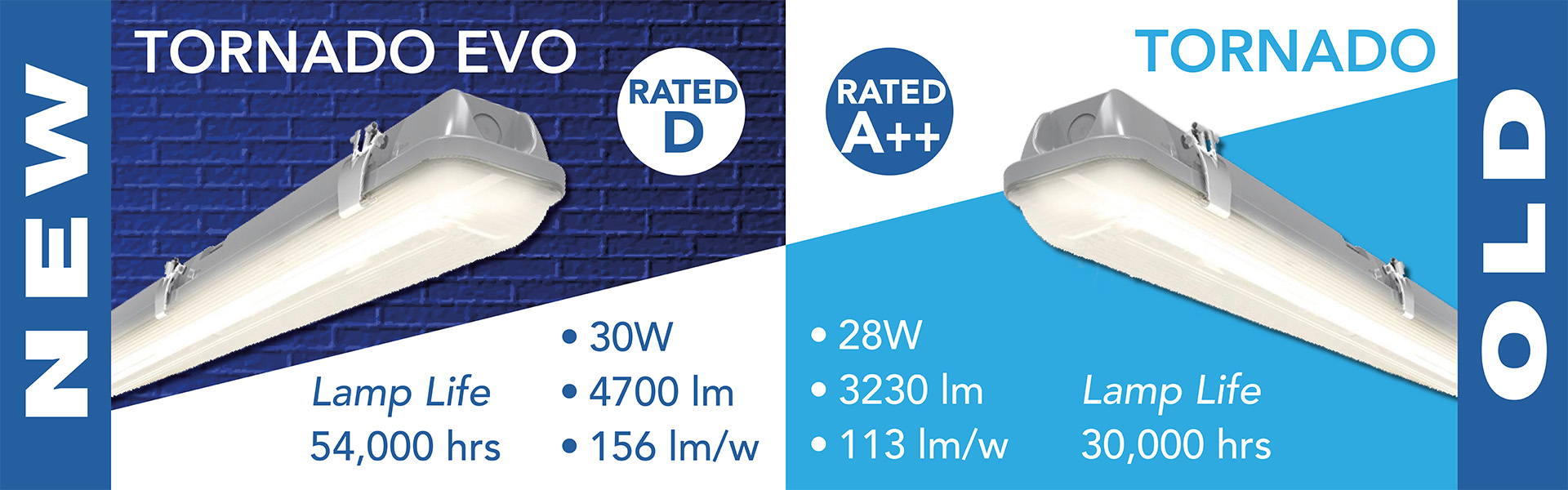
The older Ansell Tornado 5-foot LED Batten was a popular choice for many businesses. It offered 28W of power and delivered 3230 lumens, giving it a luminous efficacy of 113lm/W, which, under the old labelling system, earned it an impressive A++ rating. With a lifespan of 30,000 hours, this product was seen as a highly efficient and reliable option for various industrial and commercial applications.
The New Model: Ansell Tornado EVO LED Batten
The newer version, the Ansell Tornado EVO, has some significant upgrades. It operates at 30W and produces 4700 lumens, resulting in a luminous efficacy of 156lm/W. Despite this substantial improvement in efficiency, under the new labelling system, the Tornado EVO is rated as a D.
At first glance, this might seem like a downgrade. However, when you look beyond the label, it's clear that the Tornado EVO is more energy-efficient and offers superior performance. The luminous efficacy has increased by nearly 40%, making it a far more efficient lighting solution. Moreover, the lifespan of the Tornado EVO has been extended to 54,000 hours—nearly double that of the older model. This means less frequent replacements, further reducing maintenance costs and downtime for your business.
What Does This Mean for Your Business?
The comparison between the older and newer Ansell Tornado models highlights an important point: the new energy efficiency labels are not a reflection of inferior product quality. On the contrary, the Tornado EVO demonstrates that products have become more efficient and longer-lasting, even if the label rating appears lower.
For businesses in the hospitality, retail, warehousing, and manufacturing sectors, this means you can continue to invest in newer models with confidence. The Tornado EVO’s higher luminous efficacy and extended lifespan translate directly into cost savings through reduced energy consumption and lower maintenance requirements.
By choosing modern, efficient products like the Tornado EVO, your business can meet its sustainability goals while enjoying the benefits of cutting-edge technology. The new energy efficiency labels should be seen as a tool for better clarity, helping you make informed decisions that align with both your operational needs and environmental responsibilities.
Ansell EVO Case Study Conclusion
The Ansell Tornado EVO LED Batten is a prime example of how the new energy efficiency labels might initially seem misleading. However, a deeper look reveals that these products are more advanced, efficient, and cost-effective than their predecessors. Despite the new D label, the Tornado EVO outperforms the older model in every significant metric, ensuring that your investment is secure and future-proof.
We encourage you to explore our full range of energy-efficient products and utilise our free energy calculator to discover how much you can save with our latest offerings. Embrace the benefits of the new labelling system and let us help you make the right choices for your business.
Beyond Lighting: New Labels for Appliances
The new energy efficiency labels also apply to other electrical products, including washing machines, fridges, and freezers—products essential to industries such as hospitality and retail. These products have also seen a shift in ratings under the new system, which might cause some alarm.
However, the principle remains the same: the change in the label does not reflect a decrease in product performance. Instead, it reflects a more stringent classification system. This shift encourages manufacturers to continue innovating and developing more efficient products, benefiting businesses in the long run.
Reassuring Your Business: Why Your Investments Are Still Wise
It's natural to be concerned about the changes in energy efficiency labels but rest assured that these labels are simply a tool for better clarity and future-proofing. The products you purchase today are still among the most efficient available, and our extensive stock of high-performance LED lighting is evidence of this.
We encourage you to use our free energy calculator to see the potential savings from our LED bulbs. Despite the new labels, you’ll find that the switch to LEDs offers significant reductions in energy usage and costs.
Case Study: Under Counter Fridges – Old vs. New
Energy efficiency labels have undergone a significant shift in recent years, and one area where this change is particularly evident is in refrigeration appliances. To better understand how the new labels affect perceptions of product quality, let's examine the differences between an older under-counter fridge that was rated A under the old system and a modern model that now carries an E rating.
The Older Model: A-Rated Under Counter Fridge
The older under-counter fridge rated A under the previous energy efficiency system, was a staple in many commercial kitchens and hospitality settings. This model was considered highly efficient at the time, offering reliable cooling performance while consuming less energy than lower-rated models. However, while the A rating was reassuring, it was based on the standards and technological benchmarks available at the time.
The New Model: E-Rated Under Counter Fridge
Fast forward to today, and the new under-counter fridge, although technologically superior in many ways, now carries an E rating under the updated labelling system. At first glance, this might raise concerns about its efficiency and performance. However, it’s essential to understand what this new rating truly represents.
Factors Influencing the New Rating
Several key factors contribute to the lower rating of the new fridge:
Stricter Standards: The new energy efficiency labelling system has raised the bar significantly. An E rating today does not mean that the fridge is inefficient; rather, it reflects the much tougher criteria now in place. The scale has been recalibrated to accommodate future technological advancements, meaning today’s E could easily have been an A under the old system.
Improved Cooling Technology: The newer model features enhanced cooling technology that not only keeps food fresher for longer but also operates more efficiently under varying conditions. This might include better insulation, more efficient compressors, and advanced temperature management systems that reduce energy waste, especially during frequent door openings—a common occurrence in busy commercial environments.
Environmental Considerations: Modern fridges are designed with sustainability in mind, often using refrigerants with lower global warming potential (GWP). While these changes are crucial for reducing environmental impact, they can sometimes result in a slightly higher energy consumption, which impacts the overall rating. However, the trade-off is a more environmentally responsible appliance.
Enhanced Features: The new model likely includes features that weren’t available in older models, such as smart technology, better lighting, and more precise temperature controls. These features, while beneficial for business operations, can contribute to a higher energy consumption that affects the energy rating, even though they offer significant operational advantages.
What Does This Mean for Your Business?
Despite the E rating, the modern under-counter fridge offers several advantages over its A-rated predecessor:
Better Performance: The new fridge provides superior cooling performance, which can reduce food spoilage and ensure that products remain at the optimal temperature, critical for compliance with food safety standards.
Longer Lifespan: Modern fridges are built with durability in mind, often outlasting older models. This means fewer replacements and less disruption to your business operations.
Sustainability: Although the new model’s rating might be lower, it is likely more environmentally friendly overall. The use of greener refrigerants and energy-efficient components means your business is contributing less to climate change, which is increasingly important in today’s market.
Under-counter Fridge Case Study Conclusion
The shift from an A rating to an E rating in the new energy efficiency labels can be confusing, but it’s important to recognise that this does not reflect a decline in product quality or efficiency. On the contrary, the new under-counter fridge offers better technology, performance, and sustainability features that make it a superior choice for modern businesses.
When selecting new appliances for your business, it's crucial to look beyond the label. Consider the actual performance, lifespan, and environmental impact of the product. The new labelling system is designed to encourage ongoing innovation, ensuring that the products you choose today are not just efficient, but also future-ready.
Conclusion: Trust Lightsave to help you choose the most energy-efficient lighting and electrical solutions for your business
While the new energy efficiency labels might initially seem daunting, they are designed to simplify the evaluation process and encourage further technological advancements. For businesses across industries, the key takeaway is that efficiency and quality remain at the forefront. By focusing on the actual performance metrics and leveraging tools like our energy calculator, you can continue to make informed decisions that benefit both your bottom line and the environment.
Stay ahead of the curve with our top-tier A-rated LED lighting and energy-efficient appliances. Achieve your sustainability goals effortlessly without sacrificing quality. Connect with our expert team for unparalleled support at every stage of your journey. Whether you prefer to call us using the number at the top of the screen, chat with us live on our website, or visit us in person at our Reading store, we're here and delighted to assist you.
Credit to Carisbrook Digital for researching and crafting this blog